First Class Honours Computer Science graduate specializing in deep learning for medical image analysis. Building AI solutions that transform healthcare through explainable models and predictive analytics.
Passionate about leveraging AI to solve complex healthcare challenges
I am a First Class Honours Computer Science graduate from Afe Babalola University with a CGPA of 4.82/5.00. My academic journey has been marked by a deep commitment to excellence and a passion for artificial intelligence, particularly in healthcare applications.
Throughout my studies and internship experiences, I have developed strong expertise in deep learning, computer vision, and medical image analysis. I have built and deployed sophisticated neural networks including U-Net for brain tumor segmentation, ResNet-50 for lung cancer detection, and EfficientNet for diabetic retinopathy classification, achieving remarkable accuracy rates and practical deployment through interactive web applications.
My goal is to pursue further studies in Data Science and AI (MDSAI) to deepen my expertise in explainable AI, predictive modeling, and healthcare data science, ultimately contributing to real-world impact in medical technology.
Recognized on the Dean's List for Academic Excellence from 2022-2025, maintaining a consistent record of outstanding performance throughout my undergraduate studies.
Cutting-edge AI solutions for medical image analysis and healthcare diagnostics
Live Demo
Deep learning system for precise brain tumor segmentation from MRI scans using U-Net architecture with advanced preprocessing and data augmentation.
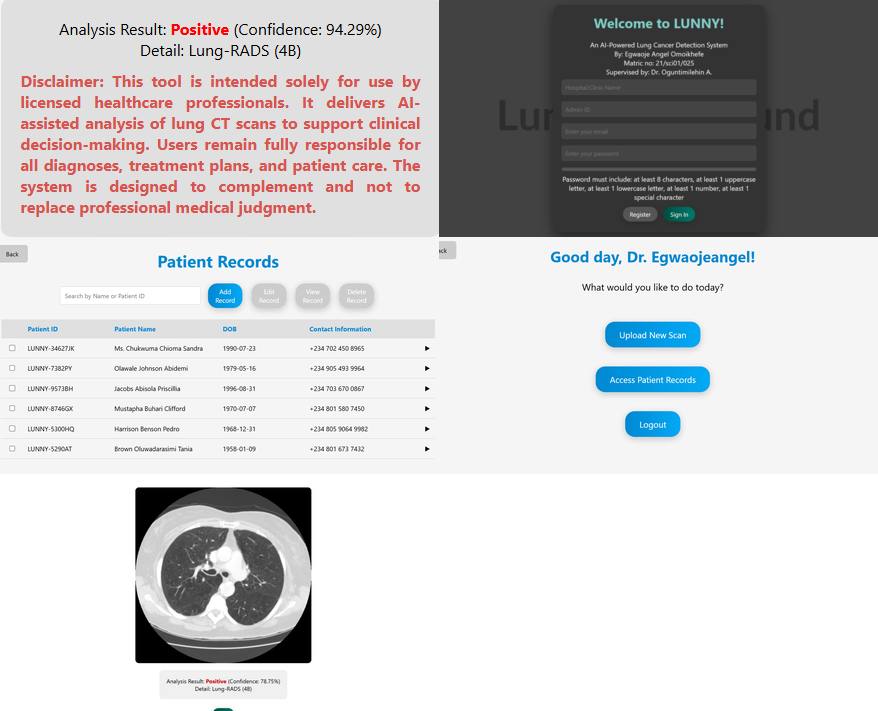
ResNet-50 CNN for accurate lung cancer detection on CT scans, deployed as an interactive Flask web application for real-time analysis.
Live Demo
Multi-class DR severity grading system using EfficientNet-B4 on fundus images with Grad-CAM explainability for clinical interpretation.
A comprehensive toolkit for AI development and deployment
Advancing the intersection of deep learning and clinical diagnostics.
Lung cancer remains the leading cause of cancer-related deaths worldwide, largely due to delays in diagnosis. This study presents a deep learning-based lung cancer detection system integrated into a secure web-based application. A Residual Network 50 (ResNet50) model was employed to analyze computed tomography (CT) scan images for early detection of lung cancer. CT images were collected from three publicly available datasets: IQ-OTH/NCCD, LIDC-IDRI, and the BIR Lung dataset. After data balancing, a total of 1,720 CT images were used and divided into training, validation, and testing sets using a 70:15:15 ratio. The model was trained to classify lung CT images as cancerous or non-cancerous. Experimental results demonstrated strong performance, achieving an accuracy of 98.46%, recall of 99.21%, precision of 97.69%, and an F1-score of 98.45%. The trained model was deployed as a web-based application named LUNNY, which enables healthcare professionals to upload CT scans and receive classification results with confidence scores to support clinical decision-making.
Hands-on AI development and research experience
I am always open to discussing AI research, collaboration opportunities, or graduate program insights